Product Review · Telescopes for Beginners
Celestron StarSense Explorer 8-Inch Dobsonian Review (2026)
4.5 / 5
Overall Rating
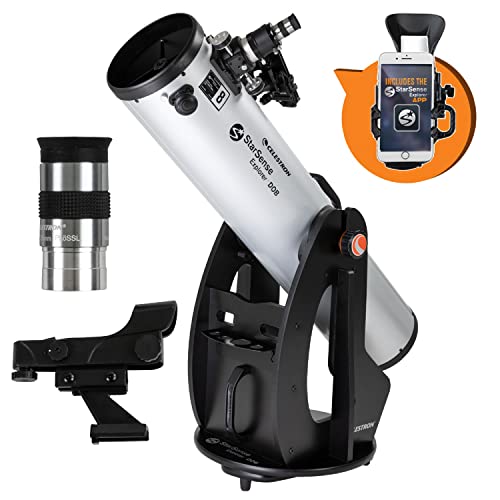
Celestron StarSense Explorer 8-inch App-Enabled Telescope – 203mm
The StarSense Explorer 8-inch Dobsonian pairs 203mm of aperture with a phone app that walks you to targets. We assess how well that push-to system works, what the scope shows, and where the compromises are.
Check PriceWe may earn a commission if you make a purchase through our links.
The Celestron StarSense Explorer 8-inch Dobsonian tries to solve the two problems that defeat most new telescope owners at once: not enough aperture to see anything impressive, and no idea where to point. It answers the first with a 203mm mirror, and the second with a phone-guided push-to system that draws arrows on your screen until the target is centered. At a street price around $880 it sits just above the entry tier, and the question is whether the app justifies the premium over a plain 8-inch Dob. After weighing the specs against the broad owner consensus, our answer is a qualified yes.
What it is
Strip away the app and this is a classic 8-inch Dobsonian: a 203mm aperture Newtonian reflector with roughly a 1200mm focal length, working at about f/5.9, riding on a simple rocker-box mount that pivots up-down and left-right. Eight inches of aperture is the traditional recommendation for the best all-around first serious telescope, and for good reason. It gathers well over twice the light of a five-inch scope and roughly eight times that of a 70mm beginner refractor. That is enough to pull in hundreds of deep-sky objects, split tight double stars, and show real surface detail on the planets.
The StarSense Explorer layer is what sets it apart. You dock your smartphone in a spring-loaded cradle with a mirror that lets the phone camera see the sky. The StarSense app photographs the star field, plate-solves it to work out precisely where the tube is aimed, and then displays directional arrows. You nudge the tube until the arrows converge and a bullseye appears, and the target is in the eyepiece. Crucially, there are no motors and no tracking. This is push-to, not go-to. You provide the muscle; the app provides the directions.
The app: does it actually work?
This is the make-or-break feature, so we weighted owner reports heavily here. The consensus is that when the app is set up correctly, it works genuinely well and takes most of the frustration out of finding objects. First-time users who could not locate anything beyond the Moon report hopping between galaxies, nebulae, and clusters on their first night out. For a beginner staring at an unfamiliar sky, that is transformative; the app collapses the steep months-long learning curve of star-hopping into something usable on night one.
Two caveats recur often enough to flag. First, the initial alignment matters: you dock the phone, run a quick calibration against a bright object, and if you rush it the accuracy suffers. Spend the extra two minutes. Second, the app relies on your phone camera seeing enough stars, so heavy light pollution or a low battery in cold weather can degrade it. None of this is a dealbreaker, but the app is an aid that rewards a careful setup, not magic.
It is worth being clear-eyed about what push-to is not. Because there is no motor, the scope does not track. Once the app centers a target, Earth's rotation slowly carries it out of the eyepiece, and at high magnification on a planet you will be nudging the tube every 30 seconds or so. That is normal for any Dobsonian, and it becomes second nature quickly, but if you were picturing a scope that locks onto Saturn and holds it hands-free, this is not that scope.
What you actually see
With 203mm of aperture, the views reward the size. The Moon is spectacular to the point of being overwhelming near full phase, which is where a moon filter earns its keep by cutting the glare to a comfortable level. Jupiter shows its equatorial cloud belts, the dance of the four Galilean moons night to night, and the Great Red Spot when it is facing us. Saturn's rings separate cleanly, with the Cassini division visible in steady air. Mars rewards patience near opposition with subtle surface markings and a polar cap.
Off the planets is where the aperture really opens up. The Orion Nebula becomes a structured, wing-shaped glow with the four-star Trapezium embedded in it. Globular clusters like M13 resolve into a sparkle of individual stars rather than a fuzzy ball. Brighter galaxies show shape and a bright core, and from a dark site the list of reachable targets runs into the hundreds. This is the payoff for hauling eight inches of glass outside, and it is a payoff a 70mm scope simply cannot deliver. If you are weighing this against a smaller, lighter option, our comparison of a tabletop versus a full-size Dobsonian lays out the tradeoff directly.
Living with it: size, weight, and setup
Eight inches of aperture has mass and bulk, and honesty demands emphasizing it. The optical tube and the rocker base are two separate pieces, and while neither is brutally heavy on its own, together they are not a one-hand carry. Most owners move the scope in two trips: base first, then tube. It stores like a piece of furniture rather than tucking in a closet, so think about where it will live before you buy. If you are in a third-floor walk-up or you will be driving to dark skies often, factor that in.
Set against that, the setup once it is outside is delightfully simple. There is no tripod to level and no polar alignment. You set the base down, drop the tube into its bearings, dock the phone, calibrate, and observe. Give the mirror 30 to 45 minutes to cool to the outside air for the sharpest views, a step worth planning around on cold nights. And like any reflector it will need occasional collimation; our guide to collimating a reflector with a cap and laser turns that from an intimidating chore into a quick routine.
Upgrades that matter
The scope typically ships with a single wide-field eyepiece, which is the right choice for using the app and framing large objects, but it leaves the high-power end of your range empty. The first upgrade most owners make is eyepieces. A kit that spans several focal lengths plus a couple of filters is the efficient way to cover the gaps.
See eyepiece kit prices on Amazon
For the planets specifically, a good 2x Barlow lens is the highest-value small purchase you can make. It doubles the magnification of every eyepiece you own, effectively turning one eyepiece into two, and an 8-inch scope has the aperture to use that extra power on Jupiter and Saturn.
Check Barlow lens prices on Amazon
Finally, a moon and planetary filter set tames the blinding glare of the Moon near full phase and can lift subtle contrast on the planets. It is an inexpensive accessory that noticeably improves comfort at the eyepiece.
See moon and planetary filter prices on Amazon
Who should buy it, and who should not
Buy the StarSense Explorer 8-inch Dobsonian if you want serious aperture, you are motivated by finding lots of objects quickly, and you have the space to store and the ability to move a large scope. It is close to an ideal first telescope for someone who is fairly sure the hobby will stick and wants to skip the years of frustration that end many beginners early. It is also a strong pick for outreach and for kids who light up at the phone-guided treasure-hunt aspect.
Look elsewhere if portability is your top priority, if you live somewhere with no room to store a piece of furniture-sized instrument, or if your budget is genuinely capped near $300, in which case a tabletop Dobsonian delivers most of the joy for a third of the price. And if you already know the sky well and enjoy star-hopping, you are paying a premium for an app you may not need; a plain 8-inch Dob costs less. To place this scope in the wider field, see our best telescopes hub and our guide to choosing a first telescope for the Moon and planets.
The verdict
The StarSense Explorer 8-inch Dobsonian is an easy scope to recommend for the buyer it is built for: a beginner who wants big-aperture views without the star-hopping apprenticeship. The app is not a gimmick; it is a real bridge over the single most common reason people quit. You pay for it in dollars and in bulk, and the push-to system still asks you to do the pushing. But as a machine for turning a curious newcomer into someone who keeps going outside, it is one of the most effective telescopes on the market in 2026.
FAQ
Does the StarSense Explorer app replace a motorized go-to mount?
Not exactly. The app tells you where to push the tube, but you do the pushing, and the scope does not track once a target is centered. A motorized go-to mount slews to a target and then tracks it automatically. The StarSense system is push-to: it solves the finding problem, not the tracking problem, which keeps the price and weight down compared with a motorized 8-inch scope.
What can you see with an 8-inch Dobsonian?
A great deal. On the planets you get Jupiter's cloud belts and moons, Saturn's rings with the Cassini division, and lunar detail down to small craters. Beyond the solar system, 203mm of aperture resolves globular clusters into individual stars, shows structure in the Orion Nebula, and reveals hundreds of galaxies and clusters, especially from a dark site.
Is the StarSense Explorer 8-inch too heavy to move?
It is bulky rather than brutally heavy. The tube and base are separate pieces, and most owners carry them out in two trips. It stores like a piece of furniture, not something you tuck in a closet, so plan for where it will live and how far you will carry it before buying.
Do I need to buy extra eyepieces for the StarSense Explorer 8-inch?
You can start with the included eyepiece, but most owners quickly add more. The scope usually ships with a single wide-field eyepiece that is ideal for using the app, leaving the high-power end empty. An eyepiece kit and a 2x Barlow lens fill in the magnifications you will want for detailed planetary views.
Does the StarSense app need cell service or the internet to work?
No. The StarSense app plate-solves the star field using your phone camera and its onboard database, so it works fully offline at a dark site with no signal. You do want a charged phone, since cold nights drain batteries faster, and a dim red-light setup to preserve your night vision.
No spam. Unsubscribe anytime.
Affiliate Disclosure