Product Comparison · Telescopes for Beginners
Tabletop Dobsonian vs Full-Size Dobsonian: Which First Scope?
A tabletop Dobsonian is cheaper and grab-and-go; a full-size 8-inch shows far more but stores like furniture. We compare aperture, portability, storage, and price to settle which Dobsonian should be your first telescope.
The Dobsonian is the telescope the internet tells every beginner to buy, and the advice is sound: it delivers more aperture per dollar than anything else. But Dobsonians come in two very different sizes, and the choice between them decides how often you will actually use the thing. A tabletop Dobsonian is small enough to live on a shelf and ride in a backpack. A full-size Dobsonian shows dramatically more but stores like a piece of furniture. Picking the right one is less about optics and more about your life: your space, your sky, and how far you are willing to carry glass.
This comparison weighs the two on the factors that actually determine satisfaction, based on spec sheets and the long-run consensus of Dobsonian owners rather than a single night's test. If you are still deciding between a Dob and a refractor entirely, start with our refractor versus tabletop Dobsonian guide, then come back here to size up.
The contenders in one glance
- Tabletop Dobsonian (around $305): roughly five inches (about 130mm) of aperture on a compact rocker base that sits on a table. Grab-and-go, apartment-friendly, cheap.
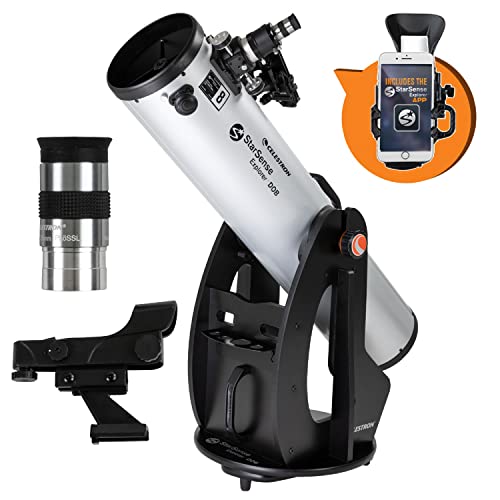
- Full-size Dobsonian (around $880 for an 8-inch): 203mm of aperture on a floor-standing base. Far more light grasp, often with a phone-guided finding app, but bulky and heavy.
Both use the same fundamentally simple, steady, motor-free mount. The differences that matter are aperture, portability, storage, and price, in that order.
Aperture: the full-size wins, and it is not close
Aperture is the single most important spec in a telescope, because light-gathering scales with the square of the diameter. An 8-inch mirror gathers roughly two and a half times the light of a five-inch mirror. In practice that gap is the difference between a galaxy as a faint gray oval and the same galaxy showing a bright core with hints of structure, or between a globular cluster as a fuzzy ball and the same cluster resolved into a shimmer of individual stars.
On the planets, both will show Saturn's rings and Jupiter's belts, but the 8-inch resolves finer detail and holds up better at higher magnification on steady nights. From a light-polluted backyard, the extra aperture also punches through skyglow to reach objects the smaller scope cannot. If the only thing you cared about were the view, the full-size Dobsonian wins every time. But that is not the only thing that matters, which is exactly why this comparison exists.
Portability and setup: the tabletop wins decisively
Here the smaller scope takes its revenge. A tabletop Dobsonian is a one-hand carry. You can set it on a patio table, a car hood, or a campsite picnic bench, and some models tuck into a large backpack for a hike to darker skies. Setup is nothing: put it down, aim, look. That low friction is not a minor convenience; it is the deciding factor in whether a telescope gets used. The most capable scope in the world shows you nothing if it stays in the closet because hauling it out feels like a chore.
The full-size 8-inch is a two-piece, two-trip affair. The optical tube and the rocker base are carried separately, and together they are heavy and awkward enough that many owners think twice on a marginal night. A padded telescope bag helps protect the tube and makes the trip to a dark site less nerve-wracking, but it does not change the fundamental fact that eight inches of aperture is a commitment to move. If you will be observing from a balcony, a small yard, or wherever you can park the car at a dark site, weigh portability heavily.
Storage: be honest about your space
This is the factor beginners forget until the box arrives. A tabletop Dobsonian stores on a bookshelf, in a closet, or under a desk. It disappears into a normal home without negotiation. A full-size 8-inch Dobsonian has the footprint of a piece of furniture and needs a dedicated corner where it can stand assembled and ready, because breaking it down and rebuilding it every session adds friction that, again, translates into fewer nights out.
If you live in an apartment or share space, this alone may settle the decision. A scope you have nowhere to put is a scope you will resent. A tabletop Dob asks almost nothing of your square footage, and that modesty is a real feature, not just a limitation.
Price: more than double, and the accessories add up
The tabletop Dobsonian comes in around $305; the app-enabled 8-inch full-size runs closer to $880. That is a meaningful gap on its own, and it widens a little once you add the eyepieces and accessories that make either scope sing. Both scopes benefit from a spread of eyepieces beyond the one or two in the box, and an eyepiece kit is a smart early purchase for either.
The value question is not simply which is cheaper. It is whether the extra aperture of the 8-inch will get used enough to justify nearly triple the price. For an observer with dark skies nearby, storage space, and a serious commitment, the answer is often yes. For a curious beginner testing the waters from a city balcony, the tabletop delivers most of the joy for a third of the outlay, and the leftover budget buys eyepieces and books.
The app factor
The full-size contender we have in mind, the StarSense Explorer 8-inch, adds a phone-guided push-to system that walks you to targets with on-screen arrows. For a beginner who does not yet know the sky, that finding aid is a genuine advantage and part of what justifies the price; our full StarSense Explorer 8-inch review digs into how well it works. Most tabletop Dobsonians are purely manual, which means you learn to star-hop, a skill that is deeply rewarding but has a steeper early curve. Neither approach is wrong; they suit different temperaments.
Which one should you buy?
Choose the tabletop Dobsonian if you live in an apartment or have limited storage, if you will travel to your observing site, if your budget is near $300, or if you want the lowest-friction path to using a scope often. It is the better first telescope for most urban and casual beginners, precisely because it removes the excuses not to go outside.
Choose the full-size 8-inch Dobsonian if you have dark skies within reach, a place to store it standing, the ability to move a heavy instrument, and a real commitment to the hobby. The aperture advantage is enormous and the app removes the finding barrier, making it close to an ideal long-term first scope for the dedicated. Both are reflectors, so both will need occasional mirror alignment; our collimation guide makes that painless either way.
The verdict
There is no universally correct Dobsonian, only the right one for your constraints. If we had to hand one scope to a typical first-timer sight unseen, the tabletop Dobsonian around $305 is the safer bet, because the scope that gets used beats the scope that impresses on paper. But if you already know you have the space, the transport, and the drive, the 8-inch full-size rewards that commitment with views the tabletop simply cannot reach. Decide honestly about your space and your sky first, then let the aperture argument break the tie. Ready to commit? Check the tabletop Dobsonian price on Amazon, or check the 8-inch StarSense Dobsonian price on Amazon. For the wider budget picture, see our best telescopes under $500 roundup and our full comparison hub.
FAQ
Is a tabletop Dobsonian good enough for a first telescope?
Yes, for most beginners it is an excellent first telescope. A five-inch tabletop Dobsonian shows the Moon in detail, Saturn's rings, Jupiter's belts and moons, bright nebulae, and star clusters, all on a mount that needs no setup. Its main requirement is a stable table or stool at a comfortable height, and its portability means it actually gets used, which is what matters most.
How much better is an 8-inch Dobsonian than a 5-inch tabletop?
Meaningfully better on faint objects. An 8-inch gathers roughly two and a half times the light of a five-inch, so galaxies, nebulae, and clusters appear brighter and show more detail, and it resolves finer planetary features on steady nights. The tradeoff is size, weight, storage, and nearly triple the price, so the extra aperture only pays off if the scope actually gets used.
Can you use a full-size Dobsonian in an apartment?
You can, but storage and transport are the real hurdles. An 8-inch Dobsonian stores like a piece of furniture and comes outside in two trips, which is manageable if you have a dedicated corner and easy outdoor access. If space is tight or you must carry it down several flights, a tabletop Dobsonian is far more apartment-friendly.
Do both tabletop and full-size Dobsonians need collimation?
Yes. Both are reflectors, so both need their mirrors aligned occasionally, a process called collimation. It is a straightforward routine that takes a few minutes with a collimation cap or a laser once you learn it, and it is worth doing periodically to keep views sharp. Neither size is meaningfully harder to collimate than the other.
Which Dobsonian is better for deep-sky objects like galaxies and nebulae?
The full-size 8-inch is clearly better for faint deep-sky objects because aperture is what makes dim galaxies and nebulae visible and detailed. From a dark site, an 8-inch reaches hundreds of such targets with real structure. A five-inch tabletop still shows the brighter showpieces well, but it cannot match the reach or the detail of the larger mirror on faint objects.
No spam. Unsubscribe anytime.
Affiliate Disclosure